
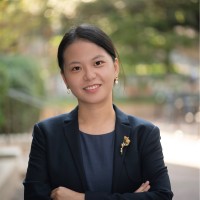
Understanding the intricacies of human interaction with artificial intelligence and algorithms is more important than ever. To advance this work, the MIT Initiative on the Digital Economy (IDE) has brought on two new researchers: Raphaël Raux and Rui Zuo.
Raphaël Raux joins the IDE from Harvard University, where he recently received a doctorate in economics. Previously, he studied economics at ENSAE Paris, L’École normale supérieure Paris, École Polytechnique and the University Pantheon-Sorbonne. Raphaël’s work focuses on behavioral, experimental and political economics.
Rui Zuo recently completed her doctorate in economics at the University of Texas at Austin, and previously studied at the University of North Carolina at Chapel Hill. Her research focuses on labor, law and developmental economics.
Raphaël and Rui both spoke recently with Jennifer Zaino, a contributing writer and editor to the IDE. Following are edited versions of their conversations.
Raphaël Raux 
Q: How does your research show the influence of observed performance on people’s reactions to AI?
The paper I co-wrote, called Human Learning about AI, speaks to the psychological mechanism of how people project their notions of human difficulty onto AI. This leads them to overreact to both hard successes and easy mistakes.
To show how this influences people’s usage of AI, we used a chatbot specializing in parental questions. Chatbots try to understand what you’re looking for based on the semantic composition of the question, which is a proxy for meaning, but not meaning itself. So they may misunderstand questions that are unreasonable for humans to misunderstand.
For example, take two questions asking for the same thing written by human users, but worded differently. They will appear equivalent to humans, but not to AI. The AI may believe that one is asking about this, the other about that.
Also, you can have cases where AI misunderstands the same question in different ways, then provides answers that are equally useless, even though one misunderstanding is more reasonable to humans than the other. We found that, among equally useless AI answers, those that are less reasonable lead to much larger breaches of trust and make humans less likely to keep asking the AI questions.
This also has consequences for AI training. One practical implication could be in reinforcement learning, where human coders rate the quality of AI answers to a series of questions. You may not want to simply maximize the quality rate of the answers; you may want to maximize the human inference-weighted success rate. We know that certain mistakes are more damaging to trust and a willingness to use the chatbot again.
Q: So human psychology plays a role in optimizing AI?
AI is remarkable overall, but it can also display “un-humanlike” patterns of performance, like being good at math but bad at physics. AI can give wrong answers to questions that are trivial for us, like stating the correct number of “R’s” in the word strawberry, while also being able to solve some of the world’s most difficult math problems.
So the notion of difficulty from a psychological perspective may be different for humans and machines. The task of getting a better understanding of exactly what kind of tasks AI is going to be good at, and what kind of tasks we can trust it with, is not trivial.
Q: What research are you planning to do at the IDE?
I joined the IDE because I think that AI and other new technology are creating an exciting time for behavioral economics. A lot of the questions about the way we interact with new technologies can best be answered through experiments. By contrast, observational data is hard to get and can only tell you so much. We don’t know what people do after they leave websites; nor do we know much about how they incorporate AI’s answers into what they produce.
Having long-term studies, where you see from start to finish how people reach a goal or produce an output with the help of AI, is important. It’s something that the Pairium AI platform — formerly known as MindMeld and co-developed by IDE Director Sinan Aral — is ideal for.
~~~~~~~~~~~~~~~~
Rui Zuo 
Q: What’s been the focus of your research?
I was born and raised in China and have always been interested in how the policies of its public institutions influence things like the workplace and workers, including inequality for migrant workers.
A major part of my thesis has to do with algorithm intervention in Chinese courts. Before 2014, Chinese courts used humans to assign cases to judges. But then the Supreme People’s Court, realizing that humans can be inconsistent, encouraged courts to use algorithms to replace humans. Now China’s courts have the freedom to choose an algorithm and decide when to adopt it.
My paper tried to evaluate how this has performed in the courts: Do the assignment patterns change, and does performance change? For example, do you get more appeals, or are they more likely to be overturned? I also looked at public opinion of the courts when humans are replaced: Do they trust the legal system more, or less?
Q: What conclusions did you reach?
It’s a mixed result. When you’re using random case assignments, there are about six more appeal cases on average every quarter per court. For machine learning “smarter” assignments, outcomes show they’re not necessarily better than humans.
Random assignment algorithms don’t care what judge is an expert in an area, or what characteristics they might have that could help them process the case better. But these algorithms are consistent and fair. Humans know potential characteristics that can make a case and a judge a good match, but their discretion may be inconsistent. By contrast, machine learning algorithms involve some extent of arbitrary assignment. They might learn from case history about characteristics. But they do not have the same nuanced observation as human beings, and they are not as random as random assignments.
Q: Now that you’ve joined the IDE, what research do you have planned?
I want to explore the fundamentals of AI and interactions with human beings. This is something that IDE Director Sinan Aral is also interested in. The majority of my work with him will involve doing experiments in a lab setting on things like, How do you deal with AI in task A, B or C? Or, How does AI react to a human being’s request to perform task A, B or C?
I also want to continue researching AI-powered policy. Is it possible to switch some roles from human to AI in governmental institutions or courts? And what would be the outcome of AI substitution or augmentation on society? AI-powered policy is happening everywhere, and I’m excited to learn more about it.