
The intersection of economics and advanced technology is an important if somewhat esoteric place. To be sure, there’s a lot of math. But there are also some hugely important questions: Will AI take our jobs? Can robots help the retired? Is social media a trap?
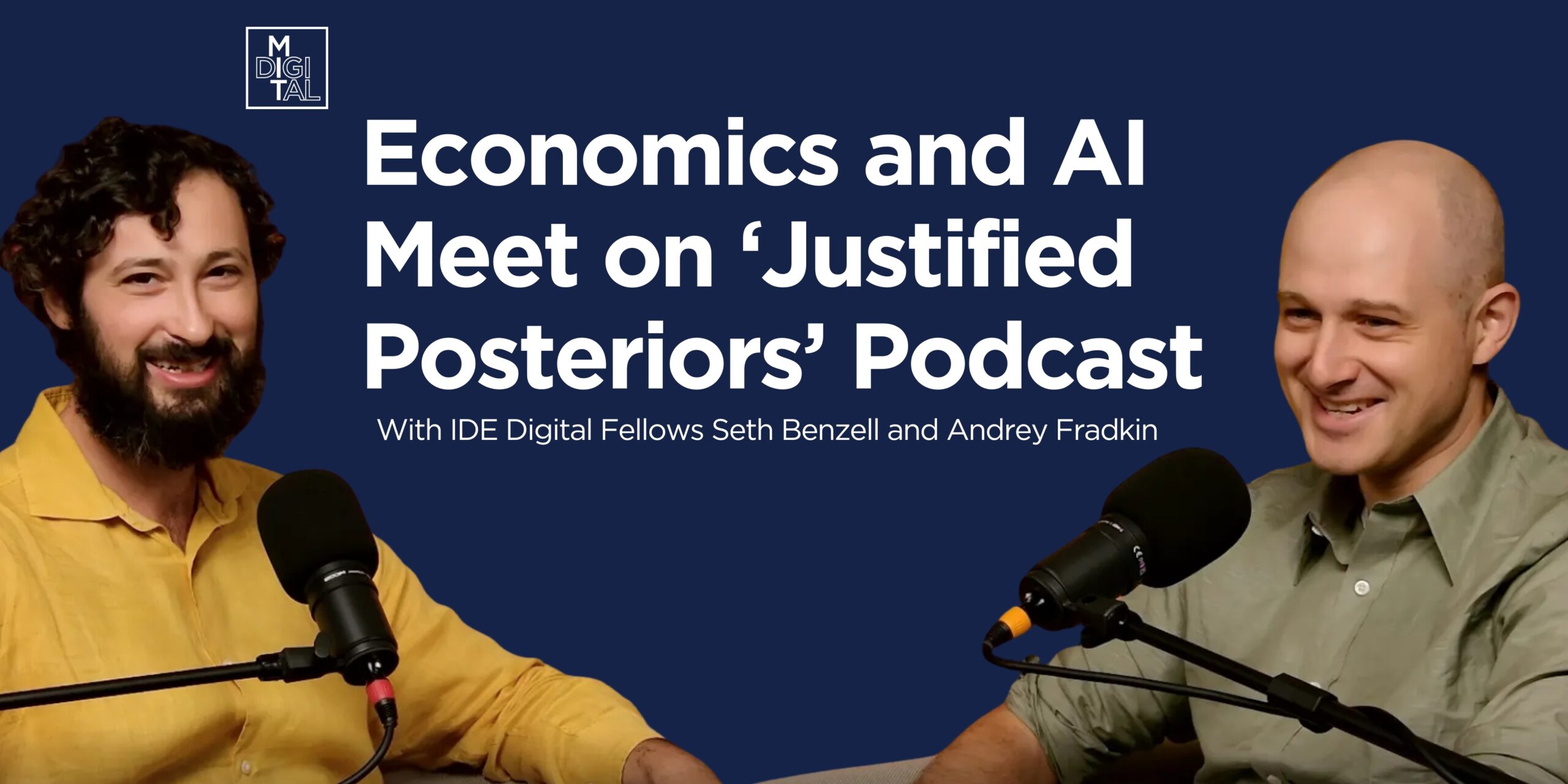
These are a few of the questions explored deeply on a podcast known as Justified Posteriors. It’s hosted by Andrey Fradkin and Seth Benzell, two Digital Fellows of the MIT Initiative on the Digital Economy (IDE).
Their podcast’s unusual title is based on a concept from Bayesian statistics having to do with the way new evidence can change old beliefs (aka “priors”) into new ones (aka “posteriors”).
But even if you don’t know Thomas Bayes from the Bay of Fundy, this podcast is worth checking out. Especially if you value deep dives into recent research on the economics of advanced tech—and enjoy the occasional foray into academic humor.
Meeting of Two Minds
The two economists behind the podcast, in addition to being IDE Digital Fellows, are both young academics. Fradkin is an associate professor at Boston University’s Questrom School of Business. And Benzell is an assistant professor at Chapman University’s Argyros School of Business and Economics.
The two met at MIT about a decade ago. At the time, Fradkin, with support from the IDE, was hosting an earlier podcast, Economic Frontiers. The two discovered they held common interests, and they decided to co-launch another podcast, this one dedicated to conversations about advanced technology and economics that were in-depth, yet also accessible and fun.

That podcast, Justified Posteriors, launched in late 2024. In their first episode, entitled “Situational Awareness,” Fradkin and Benzell discussed the implications of artificial general intelligence (AGI), a hypothetical form of AI that could match or even surpass human capabilities. Setting an agenda for future episodes, they based their hour-long conversation on a single paper, in this case, a long essay by AI researcher and investor Leopold Aschenbrenner.
“Our framing device,” Benzell recounts, “was asking, ‘What did we actually learn from this paper? And after reading it, did our beliefs actually change?’”
Going In-Depth
In subsequent episodes of their podcast—Benzell and Fradkin regularly produce two a month, each roughly 60 to 90 minutes long—the hosts have explored a wide range of topics related to tech and economics. These include:
- The Economics of Book Slop: This discussion is based on a paper by two economics professors, Imke Reimers and Joel Waldfogel, in which they explore whether large language models (LLMs) can boost the creation of valuable books. In a brief detour, the hosts touch on Borges’ short story, “The Library of Babel.”
- The Most Important Philosophical Treatise of the 21st Century? A deep dive into Anthropic’s “Claude Constitution,” which describes the company’s intentions for its AI model’s values and behavior. “Sometimes it reads like an Old Testament set of commandments from the mountaintop,” Benzell says. “Sometimes like a letter from a father to his child. And sometimes like a technical manual. But it’s always interesting.” To which Fradkin replies: “I thought it read like what my life coach tells me to do. Create value, be authentic, and be engaging.”
- Should AI Read Without Permission? Some LLMs get trained with content that is unauthorized or even pirated. Is that okay? This topic gets the host’s attention with the help of a working paper, “Cloze Encounters,” by economists Stella Jia and Abhishek Nagaraj. (The title puns on cloze test, an assessment that can be used to evaluate the performance of natural language processing (NLP) models.)
In other episodes of their podcast, Fradkin and Benzell converse with distinguished guests. These include:
- Noah Smith, one of the world’s top economics bloggers. He expounds on topics that include blogging, AI economics, and elite overproduction.
- Kevin Bryan, a professor of strategic management, discusses technology bottlenecks, AI in China, and what economists should actually be working on.
- Martha Gimbel, executive director of the Yale Budget Lab. She explains why the much-feared “AI job apocalypse” has failed to materialize, at least so far.
Room to Grow
The Posteriors podcast is widely available on Substack, Spotify, Twitter/X and YouTube. But given the podcast’s unapologetically rigorous approach, it has attracted a select audience of a few thousand followers.
That could change soon, as the two hosts are working to scale their fandom. They recently hosted a party for Posteriors fans attending the National Bureau of Economic Research’s Summer Institute in Cambridge, Mass. And they’re planning to interview some higher-profile guests that should attract a larger, broader audience. Other related events and projects are in the works, too.
Take a listen. Your posteriors will definitely be justified.
- Check out the Justified Posteriors podcast.
- And meet the podcast’s hosts:
Peter Krass is a contributing writer and editor to the IDE.