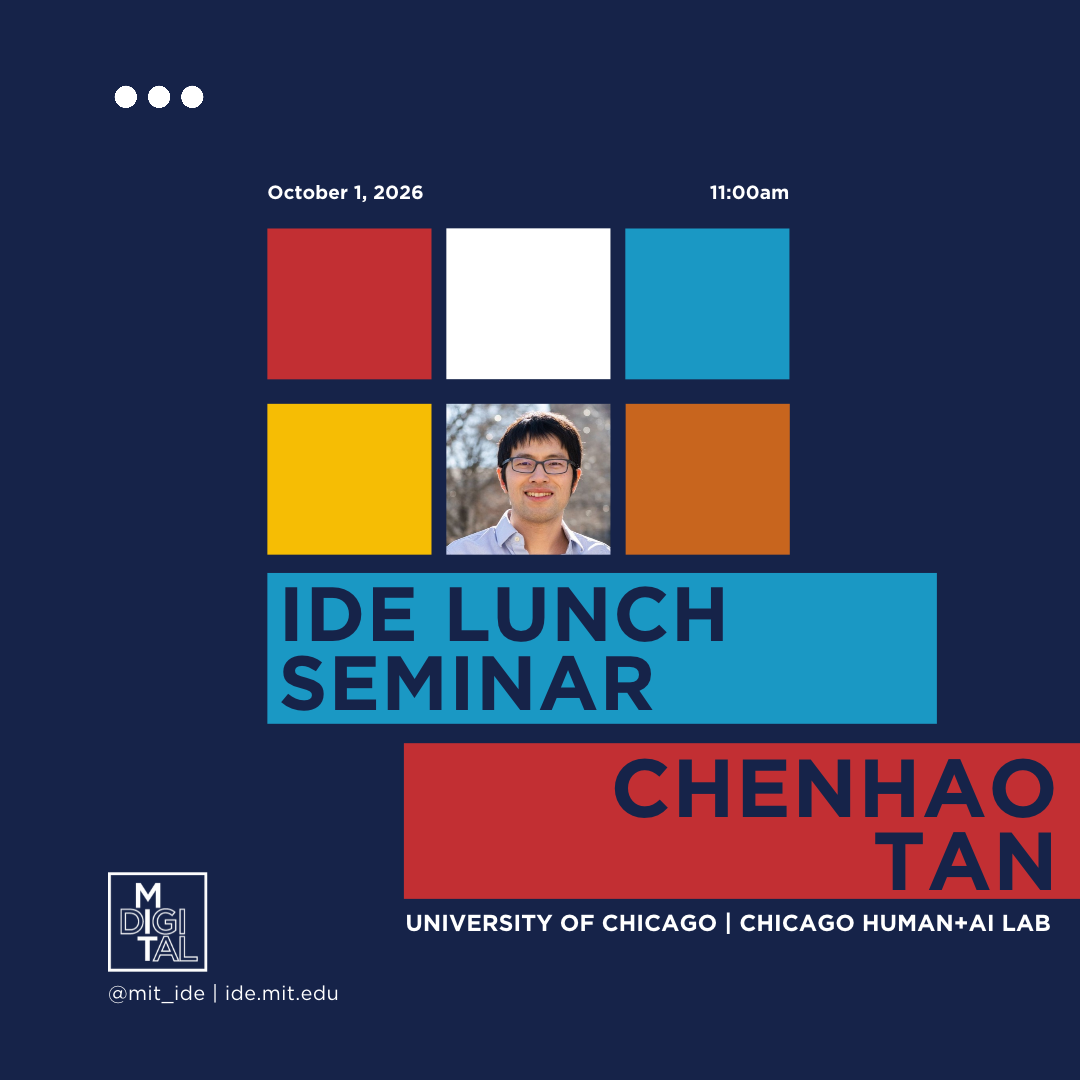
Join us in person or virtually via Zoom for the first IDE Lunch Seminar of the Fall 2026 semester, featuring Chenhao Tan's presentation, "Three Acts of AI Scientists."
Register for in person above.
Register to join virtually (via Zoom)
HERE
Three Acts of AI Scientists: Abstract
As AI becomes increasingly capable of following instructions and conducting analyses, how will the roles of scientists and the scientific ecosystem change?
In this talk, Chenhao Tan will explore AI scientists through three acts. First, he will present our work on automating scientific verification, including execution-grounded evaluation of mechanistic interpretability research and replication of ICML papers. Second, he will introduce NeuriCo and discuss the capabilities and limitations of autonomous AI scientists through example research projects. Finally, he will consider where the future lies: as AI expands our capacity to produce research, selection and evaluation become increasingly important.
Tan will argue that realizing the promise of AI for scientific discovery requires rethinking the ecosystem that determines which questions we pursue and how we assess the resulting work.
Meet Chenhao Tan
Chenhao Tan is an Associate Professor of Computer Science and Data Science at the University of Chicago, and directs the Chicago Human+AI Lab. He earned his PhD in Computer Science from Cornell University and dual bachelor’s degrees in computer science and economics from Tsinghua University. His research focuses on human-centered AI, communication & intelligence, and AI alignment. His work has been covered by major news media outlets, including the New York Times and the Washington Post. He also won a Sloan research fellowship, an NSF CAREER award, an NSF CRII award, a Google research scholar award, research awards from Amazon, IBM, JP Morgan, and Salesforce, a Facebook fellowship, and a Yahoo! Key Scientific Challenges award.