

How are companies successfully integrating AI into workflows? Who’s seeing ROI at this point? Where does human expertise and oversight fit in? And what does this mean for the future workforce?
Recent work from the MIT Initiative on the Digital Economy sheds light on how AI adoption is playing out in 2026. Drawing upon data from some of the largest companies operating today, the MIT IDE’s research provides a clearer picture of how AI adoption is being executed, what works, and where more work is needed.
AI adoption in the enterprise: MIT IDE quick insights from 2026
- Adoption is shallower than the headlines suggest. Only 11% of S&P 500 firms had AI deeply embedded by the end of 2025.
- AI agent adoption took off when training and support came with the tools. At OpenAI, it followed a company-wide push with training and regular feedback.
- AI works best alongside human expertise. Automation changes which expertise a job demands, and accountability stays with people.
- Customers are still wary. Only 36% trust agentic AI with their data, so trust must be built alongside the tools.
- AI will impact the future workforce, and the effects will be uneven. Outcomes will diverge by occupation, industry and employer.
In this article, we’ll highlight MIT IDE research on AI adoption and how they can potentially answer key questions business leaders are asking today.
Is AI adoption as widespread as the headlines say?
No, according to SEC filings analyzed by MIT IDE and MIT Future Tech research scientists. By the end of 2025, just 11% of S&P 500 firms had AI deeply embedded in their business. Two-thirds of that deep integration is happening at tech companies. Another 45% of S&P 500 companies were running AI pilots, many of which likely won’t move into full production.
To better understand what’s happening within major companies, the MIT researchers behind AI Adoption in S&P 500 Firms analyzed 10 years of U.S. Securities and Exchange Commission (SEC) 10-K filings from 510 companies. These federally mandated public disclosure forms are held responsible for accuracy and completeness, offering a clearer picture than marketing statements.
They found not only uneven AI adoption, but also that the gap between industries is striking. Half of tech firms reached deep integration, compared with about 4% of financial services firms, even though 68% of those firms are heavily piloting AI.
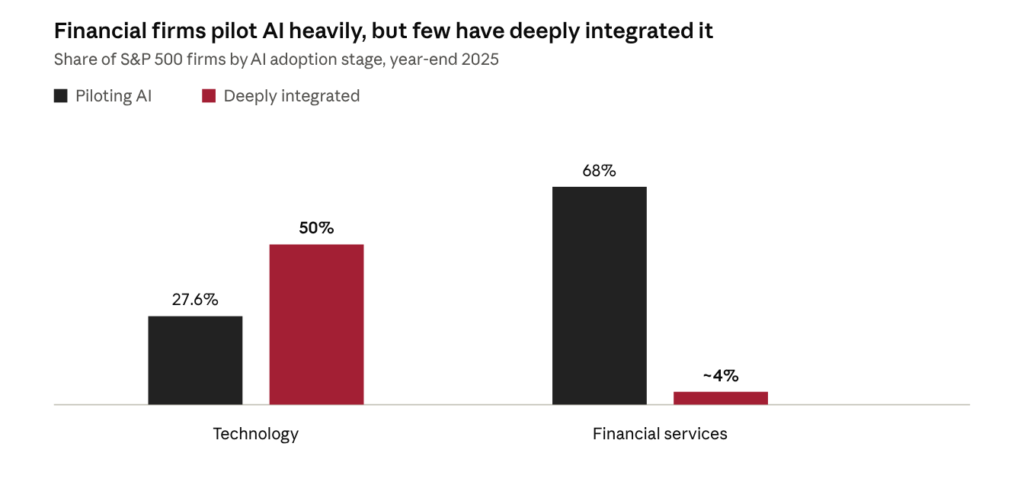
Source: AI Adoption in S&P 500 Firms (MIT IDE and MIT FutureTech), via the IDE article. Financial services pilot figure is reported as heavy pilot activity; deep integration is about 4%.
Read more: Pulling Back the Curtain on Enterprise AI Adoption
Where are companies on the AI J-curve?
Most are still in the dip. Research shows AI adoption follows a J-curve: companies in the early stages often see lower profit margins; the payoff comes later. The S&P 500 research showed that tech firms with deep AI integration eventually see a 3% margin improvement, and non-tech firms that use AI to make goods or deliver services see 5%. But with only 11% of S&P 500 firms deeply integrated, most haven’t gotten there.
What’s more, margins have improved for those companies, but productivity gains haven’t shown up yet.
Why haven’t companies seen big productivity gains?
The researchers of the S&P 500 papers suggest several possible causes: organizational friction, bottlenecks elsewhere in the business, or a lag effect where gains simply haven’t shown up yet. Other MIT IDE research also helps explain why.
In the working paper Chaining Tasks, Redefining Work: A Theory of AI Automation, John Horton and his co-authors show that small improvements in AI quality can change little at first, especially in the early days of adoption. Once quality crosses a threshold, AI can take on longer sequences of steps at once, and the best way to organize work shifts sharply.
The researchers say this offers a foundation for the productivity J-curve. Returns from better AI don’t rise smoothly. They’re slow at first, then jump when work gets reorganized around better tools.
What makes a successful AI agent?
At OpenAI, AI agents went from side tool to default, a jump that coincided with company-wide training sessions and regular feedback. The result? Codex, OpenAI’s agentic AI tool, went from under 10% of the average worker’s AI output in August 2025 to 99.8% by June 2026, according to the working paper The Shift to Agentic AI: Evidence from Codex. The shift went well beyond engineers: legal and recruiting teams went from near-zero Codex use to nearly 90% of their AI output in about five months. What changed?
McKinsey’s 2026 State of AI report found that 40% of large organizations, those with annual revenues above $1 billion, are now scaling AI agents, up from 27% the previous year. The Codex paper’s authors say the biggest payoffs will go to companies that redesign workflows, roles and review processes. As they write, “the largest productivity gains often arise when firms reorganize production around the new technology rather than merely substitute it into existing workflows.”
Read more: Inside OpenAI’s Shift to AI Agents
How should AI work alongside human expertise?
A major decision for leaders is how many tasks to hand over to AI and which ones need a human touch. The working paper Expertise offers some perspective. MIT researchers David Autor and Neil Thompson, a research lead at the MIT IDE, studied four decades of automation across 303 U.S. occupations. Where automation took over expert tasks, wages fell and employment rose, because less specialized workers could enter. Where it took over routine tasks, what remained demanded more expertise, so wages rose and employment fell.
The paper looks at automation broadly, not AI alone, but it raises the question leaders now face: is AI taking over the expert work or the routine work?
Where to keep humans in the loop has become an important question for enterprises. Accountability can get tricky when agents carry a significant share of the workload. Some companies are testing treating agents as co-workers. But a study by an IDE team led by Digital Fellow Emma Wiles, an assistant professor at Boston University’s Questrom Business School, found the practice can backfire.
Among managers whose organizations already had AI employees, those reviewing work from a named AI colleague cut their monitoring intensity by 16% compared with those reviewing work from an unnamed AI tool. Accountability also shifted from people to the AI, and treating agents as employees did not increase AI adoption. As one manager told the researchers, “If you want people to feel like they can be easily replaced by AI, then put AI on the org chart.”
Read more: Adding AI to the Org Chart? Do It with Intention
Do customers trust AI?
Not yet. Customers trust AI less than companies do, so businesses need to build trust alongside the tools. At Salesforce Connections 2026, Renee Richardson Gosline, a behavioral scientist who leads the Human-First AI research group, shared that 81% of professionals trust agentic AI with customer data, but only 36% of customers agree.
Gosline’s research points to three ways to close that gap. Agents earn more trust when their reasoning mirrors the user’s own. A little friction helps too: having a person play back an agent’s rationale keeps people from relying on it too much or too little. And trust grows when companies exchange value with customers rather than extract it.
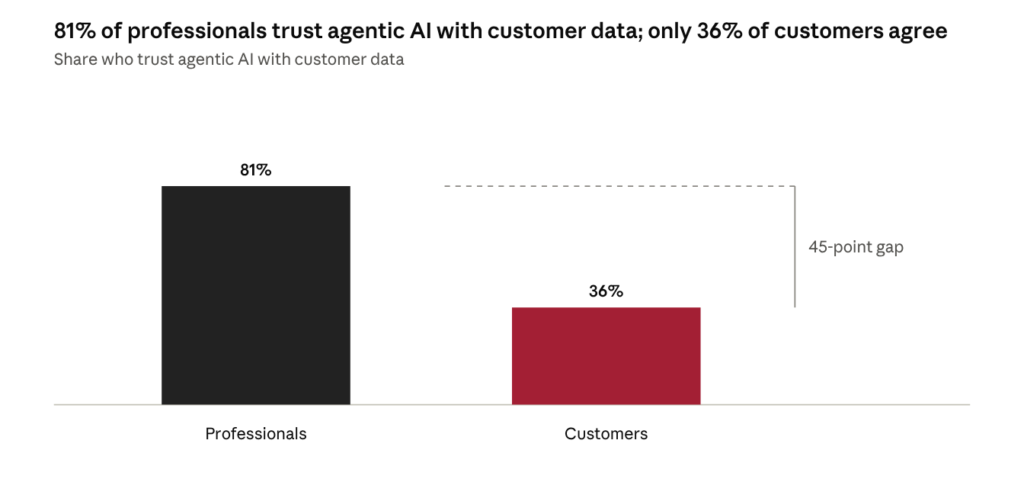
Source: Dr. Renee Gosline, Salesforce Connections 2026, Is AI Impacting Consumer Trust?
Watch: Is AI Impacting Consumer Trust? (Salesforce+)
What’s AI’s impact on jobs and the workforce?
AI’s impact on jobs is too big and too complex to leave to market forces, according to MIT researchers Guy Ben-Ishai, Researcher and Senior Advisor at MIT FutureTech, and Neil Thompson. After reviewing years of economic research, they found no support for either mass unemployment or across-the-board augmentation. Instead, outcomes will diverge by occupation, industry and employer.
Ben-Ishai and Thompson’s paper for the Brookings Institution, Workforce Policy for the Age of AI, recommends five policy responses:
- Prioritize displaced workers and high-productivity opportunities.
- Design domain-specific training with employers.
- Align programs with shifts in human expertise.
- Expand apprenticeships.
- Establish a federal wage-insurance program.
Read more: AI’s Impact on Jobs Demands a New Approach and New Public Policies
Will AI take our jobs? MIT’s Neil Thompson explains why AI automation may look like a rising tide
What should businesses watch for in 2027?
As you look ahead to 2027, the research offers some insights worth keeping an eye on: How long AI takes to pay off, how work gets redesigned around it, whether customers trust it, and how ready your workforce is.
1. Count integration, not pilots
The margin gains in the S&P 500 research showed up at companies with deep integration, not at those still piloting. So, the number of pilots running tells you little about how close the payoff is. The Chaining Tasks paper adds another thing to watch. Progress can feel flat until AI quality crosses a threshold, and then the best way to organize work shifts quickly. Be ready to reorganize when it does.
2. Redesign the work, and keep people accountable
Across these studies, the pattern is the same: Gains come from changing how work gets done, not from adding a tool. OpenAI’s agents took off with training and feedback, and the Chaining Tasks paper points to reorganizing how jobs are designed. The Expertise paper shows why it matters: what’s left for people changes depending on which tasks you hand over.
Companies should also watch the handoff points. Who checks the agent’s work, and who answers for it? Emma Wiles‘s research suggests that naming agents and treating them as employees can loosen human oversight instead of tightening it.
3. Earn customer trust before scaling agents
Professionals trust agentic AI more than customers do, so enthusiasm inside the company is a poor guide to how customers will respond. According to Dr. Gosline’s findings, showing customers the agent’s logic, adding some beneficial friction, and giving value back to customers—rather than only extracting it—helps establish that trust.
4. Prepare workers for uneven change
Watch who gains and who loses. Neil Thompson’s work shows that change likely won’t come as a crashing wave, but more gradually like a rising tide. He also found automation can raise wages in some jobs and lower them in others, depending on whether it removes expert or routine tasks.