
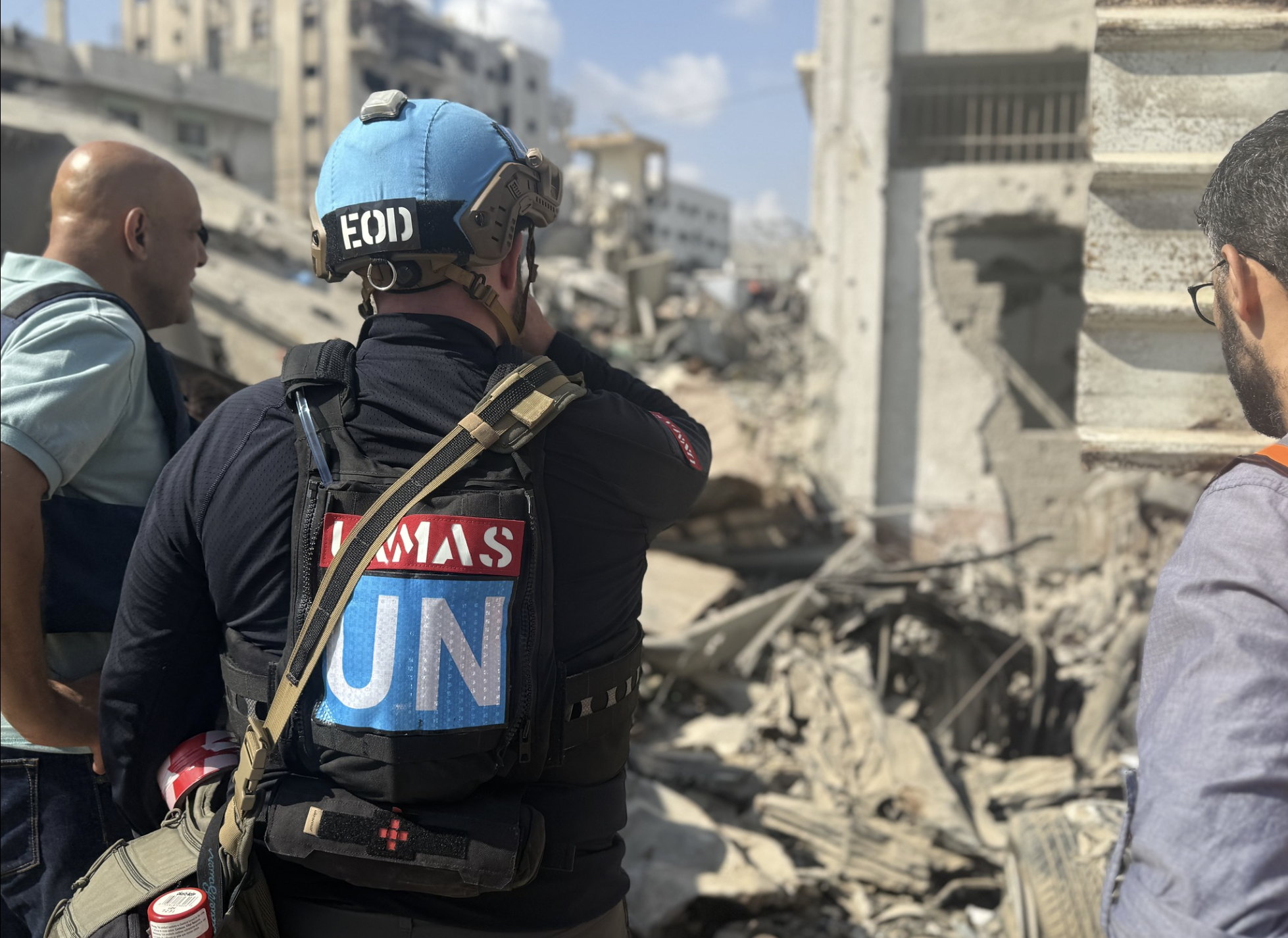
When a disaster hits, minutes matter. In a crisis, the United Nations Office for Project Services, or UNOPS, is there to assist with rapid response, helping UN partners identify and address the most urgent needs in affected communities. Its goal is to provide fast, effective and efficient assistance that meets urgent needs, as well as lay the groundwork for a more sustainable future.
UNOPS assessments rely on operations managers manually reading incoming alerts, reconciling information from dozens of sources, and making capability decisions largely from experience and instinct. Eying advancements in technology—especially AI—UNOPS was looking for a way to respond to emergencies smarter and faster.
A MIT student team spent the spring semester taking up that challenge. The tool they built, Augur, compresses the time needed to generate an initial, structured prioritization analysis from hours to roughly 8 seconds. The real value is not in the tool’s speed alone. Augur also built in transparency, traceability, and ensuring humans stayed in the loop. The resulting tool helps operational teams move faster from assessing the data on an incoming disaster to understanding how resources could be planned and allocated more effectively.
The Challenge: Manual Triage in a Fast-Moving Crisis
The project was part of GenAI Lab, one of two Action Lab courses run by the MIT Initiative on the Digital Economy through MIT Sloan. GenAI Lab pairs MIT student teams with organizations across the globe to design and build practical AI solutions, with a focus on strategic implementation and real-world impact. This challenging and competitive course awards the best projects with trophies and bragging rights.

During the first stage of the class, student groups select their preferred projects, aiming to partner with an organization that offers the opportunity to build something innovative and meaningful.
UNOPS described three compounding bottlenecks during the first 24-48 hours after disaster strikes. First, volume and variety. Incoming information and alerts needed to be assessed quickly.
Second was missing context. A raw alert tells them something happened, but nothing about exposed population, damaged infrastructure, or which UNOPS capabilities are relevant.
Third, no structured path from event to action. Matching UNOPS’ capabilities to a disaster relied entirely on the institutional knowledge of experienced operations managers, with no audit trail and no consistent method.
The cross-functional team—Philipp Zinnenlauf, Betsegaw Wosoro, Margar Harutyunyan and Herbert Traub—chose UNOPS deliberately.
This was an opportunity to use our technical skills to help operators assist people in dire situations more quickly,” Zinnenlauf explained, “rather than improving efficiency metrics marginally in a for-profit context.”
Building the Solution: Turning Alerts into Evidence-Grounded Decisions
The team framed this as a decision-support problem, not an automation problem. The goal wasn’t to replace operations managers but to carry them faster from a raw, messy alert to a scored, prioritized recommendation with a citable evidence trail, inside the early-action window.
The build split into two interlocking efforts. The first was LLM engineering. The team built an extraction layer that reads unstructured, multilingual reports from varied sources and converts each one into a structured “Disaster Profile” that captures damage signals, affected population, infrastructure exposure, and operational constraints. These profiles are then scored for impact and urgency in line with state-of-the-art research methodology.
The second effort was a Retrieval-Augmented Generation (RAG) architecture. The team assembled a vector database of 405 historical UNOPS responses spanning 73 countries and 17 years. For each new event, the system retrieves the closest precedents and generates a ranked recommendation where every claim traces back either to a real historical case or to the UNOPS mandate. Scoring, evidence tiering, and validation all run in deterministic code, keeping the system auditable and preventing it from overstating its confidence.
One of the harder problems was validation. Without a ground-truth dataset of “correct” UNOPS responses to measure against, the team built a five-scenario gold standard and a large-scale test inventory.
In a high-stakes environment where a fabricated figure or a misplaced recommendation could misdirect a real response, that hands-on rigor was non-negotiable,” Wosoro said.
Meet Augur: A Tool for High-Stakes Decision Making
The result is Augur, an LLM-driven decision-support engine that organizes its work in two phases. The first is disaster profiling and scoring. This system converts incoming alerts into standardized disaster profiles and computes a composite impact and urgency score.
The second is capability matching and recommendation. Here a RAG engine takes each profile, retrieves the five most similar historical UNOPS operations from its corpus, and generates a ranked recommendation tiered by the strength of the evidence.
The two phases converge in a unified ranked-alert dashboard, where each event appears as a card which carryies its profile, impact score, and tier-graded recommendation. For context, it includes confidence levels, caveats, and next actions.
The tiering framework assists UNOPS in quick decision making. It distinguishes direct precedents, such as what has happened before in the same country or during a similar disaster type, from analogous ones, such as the same event type, but in a different region. If historical matches are limited, it relies on strategic inference.
The framework came directly out of conversations with the UNOPS team and mirrors how experienced operations managers reason when a new event comes in.
The Outcome: A Deployable System for Disaster Response
Augur is a working, end-to-end pipeline, offering a full vector database of historical disaster interventions and a validation report on example disasters. In testing, time-to-decision compressed from hours to roughly 8 seconds per alert. Across all evaluation scenarios, there were zero hallucinated case citations. Every recommendation was traceable to a real historical precedent or an explicit mandate clause.
The system is designed to deploy natively on UNOPS’s existing technology stack. When inputs are incomplete or degraded, it flags its own gaps rather than fabricating figures. This design choice was essential, the team decided, because misleading outputs could redirect real relief efforts.
How UNOPS and GenAI Lab Collaborated
Both UNOPS and the GenAI-Lab team agreed that ongoing communication was the key to their success. UNOPS was closely involved throughout the project and their feedback shaped design decisions in real time.
UNOPS plans to deploy Augur within its own tech stack, where operations managers will use the tool to respond to disasters across their respective regions.
The tool can certainly help solve some real problems we face in UNOPS,” said Rory Collins, Global IM and Analytics Advisor, UNOPS. “The 24- to 48-hour window is key for our operations teams so, the fact that this team got it down to around 8 seconds with a proper audit trail is a win.”
“The real added value of the tool is not only that it makes the analysis dramatically faster, but that it does so in a way that remains transparent, auditable, and interpretable,” said Lionel Fragniere, Head of Applied Research, UNOPS Compass. “This gives us a strong foundation to move from data to actionable prioritization, and to engage clients around where UNOPS’ impact could matter most.”
More Than a Class, Meaningful Results
For Zinnenlauf, Wosoro, Harutyunyan and Traub, the project offered the chance to build something consequential under real constraints with a real partner. The project also shaped how they think about AI development more broadly. In their words, it demonstrated “a practical path toward using Generative AI not merely to automate tasks, but as a decision-support layer that keeps humans in the loop.”
“Building technology that people value is what most builders are after in the first place, and knowing this one could be put to use in the UNOPS context, where the stakes are measured in lives rather than metrics, makes it that much more meaningful,” Zinnenlauf reflected. “That’s a rare thing to be able to say about a class project.”