

- A study of 21,000 consumers found AI-generated personalized video ads outperformed both image ads and generic video in click-through rates.
- The results are promising, but researchers say questions around novelty, privacy, and quality at scale warrant closer examination before widespread adoption.
- AI-personalized video offers marketers real potential, but efficiency gains shouldn’t come at the expense of human judgment or respect for consumer trust.
When you open your next email, you may find a video of a friendly spokesperson talking directly to you—using your name—and thanking you for being a great auto insurance customer. Maybe she’ll ask whether you’ve thought about taking out a home equity loan, or if you need new boots for winter.
Personalized marketing videos created with generative AI have become increasingly popular with marketers looking to cut through the noise and elevate customer experiences. Research scientists at the MIT Initiative on the Digital Economy have found they’re doing just that and getting more clicks than less tech-savvy content.
Beyond these promising findings for marketers, their paper, Frontiers: Generative AI and Personalized Video Advertisements, asks another important question: If AI personalized videos are engaging customers now, how long will that last?
Automating a personalized experience
To examine whether AI-generated personalized videos engage customers in a meaningful way, Madhav Kumar, an assistant professor at Harvard Business School and digital fellow at the MIT Initiative on the Digital Economy, and Anuj Kapoor, an Assistant Professor of Marketing at the University of Missouri, conducted an online experiment involving over 21,000 consumers. The duo worked with three organizations: a GenAI technology company, an Indian e-commerce retailer selling eco-friendly products, and a WhatsApp marketing provider.

Dividing the customers into three groups, Kumar and Kapoor delivered a different type of ad to each:
- An AI-generated avatar, synchronizing the avatar’s speech and facial movements with customized text scripts.
- A personalized image ad with text, the current industry standard for WhatsApp Marketing.
- A video ad with generic content identical for all recipients.
The results found that click-through rates (CTRs) for the AI personalized videos were 9.4% higher than the personalized image ads and 6.5% higher than the generic videos.
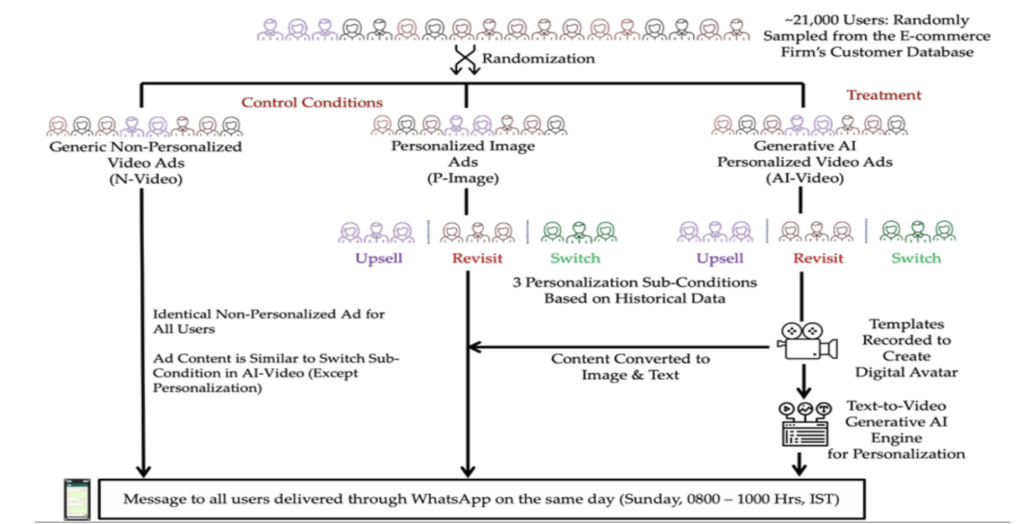
Experimental design for targeting users with GenAI-created personalized video ads
Important to note, when creating the personalized videos ads, the marketing team retained full control over message content, using GenAI as a production tool rather than as a creative engine.
Clear AI ROI, but how long do the benefits last?
More than 40% of US agency and marketing professionals are already using GenAI to produce multiple versions of creative for video ads, according to a 2025 report from the Interactive Advertising Bureau (IAB). And it’s easy to see why.
Companies can quickly and cheaply create personalized video campaigns for customer retention, product launches and targeted promotions. It potentially solves the problem of personalization at scale, enabling companies with large customer bases to drive meaningful revenue. Thinking long-term, personalized AI videos and the quick production time could make marketing departments more agile, responding faster to trends and shifting market conditions.
But Kumar and Kapoor note that this single-exposure experiment warrants further consideration. While the CTRs were improved, was the cause personalization or the novelty of the tech?
When does personalization get too personal
There’s an art to creating personalized video ads with GenAI — and a science. Kumar and Kapoor said companies need to balance GenAI’s scalability benefits with quality control and privacy considerations for them to be effective.
Over-personalization has its risks. Gartner says that almost half of customers perceive personalized communications as either irrelevant or intrusive. In the experiment, Kumar and Kapoor used generative AI to create personalized ads targeted to consumers’ personal purchase histories. If AI-generated ads use purchase history, behavioral or location data in ways that feel a little too pinpointed, it may cause unease — or feel downright creepy.
AI advertising has also caught the attention of the Federal Communications Commission (FCC), which has implemented AI transparency requirements for TV and radio producers to disclose when AI is used in political ads. Such content may be cheaper to make, but it also raises concerns about trust and misinformation, especially when it could impact important decisions like voters’ choices.
Trust in AI personalized ads: Too early to tell?
The researchers say more work is needed to understand the actual effectiveness of AI personalized ads. The attention-grabbing nature of a personalized video could have prompted clicks but may wear off the more commonplace these ads become. Effectiveness may also depend on industry and market, the researchers note. And while the advantages of cheap and fast are appealing, Kumar and Kapoor raise the question of quality at scale: If it diminishes the more you produce, it could limit effectiveness in broader deployments.
Use AI personalized video ads with caution
Marketers that plan to create personalized videos with generative AI should plan how to overcome these challenges. Kumar and Kapoor warn in their paper’s findings that privacy and transparency concerns surrounding AI usage require careful navigation. Personalization can cross into intrusion, and automation can eclipse authenticity. Note that these AI ads were created with heavy human involvement. GenAI can elevate storytelling, but research suggests it works best when guided by human judgment.