
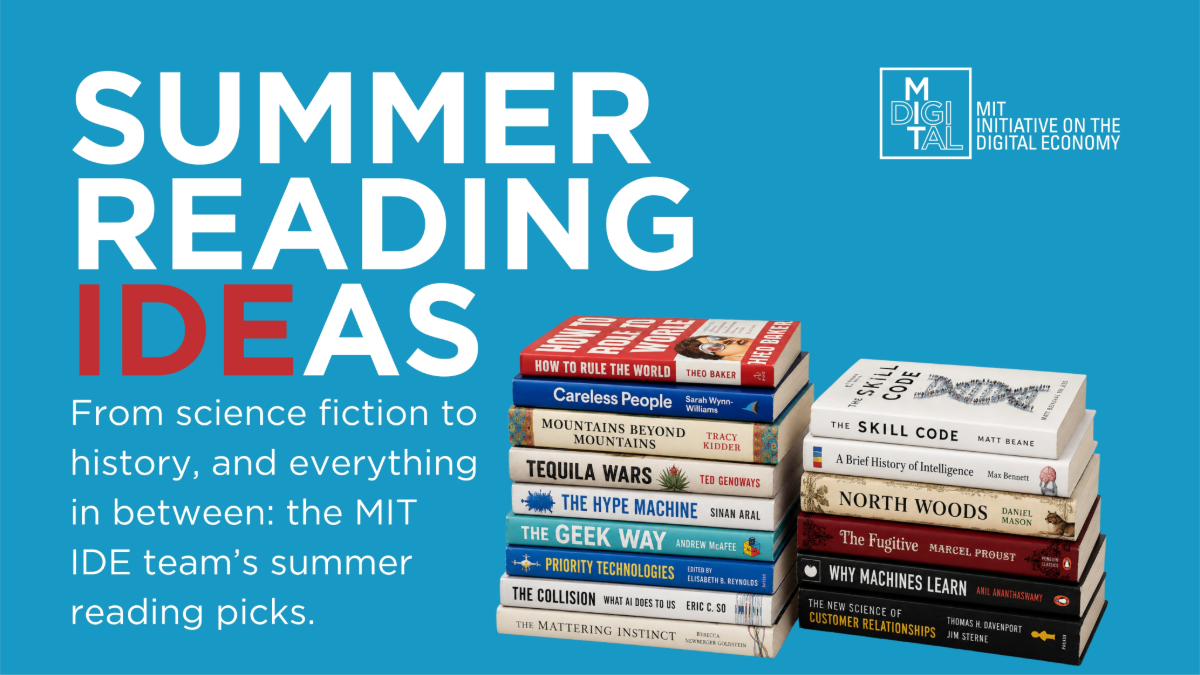
Summer’s here, and the time is right for reading on the beach…at a picnic…or even in your air-conditioned living room. But with so many books and so little time, picking that perfect summer read isn’t easy.
The MIT Initiative on the Digital Economy (IDE) is here to help. Here are your summer-reading recommendations from our staff and associates. The books we recommend range from explorations of the latest tech to a recounting of Mexican history. All have been read and approved by our team.
You’ll also find a list of books written, either in part or in whole, by members of the IDE community. They’re well worth your summer reading, too.
Happy summer from the IDE, and even happier reading!
Non-Fiction

The Tequila Wars: José Cuervo and the Bloody Struggle for the Spirit of Mexico, by Ted Genoways (W.W. Norton, 2025)
Recommended by: David Verrill, Executive Director of the IDE. David has worked for and consulted to MIT for over 30 years.
Why it’s recommended: Let’s face it, I am a tequila aficionado and I much prefer non-fiction. This book is a historical biography of Jose Cuervo (the “father” of tequila in Mexico) who modernized the industry, developed the first cartel to support distribution, and helped make tequila THE spirit of Mexico. In the last decade there has been an explosion of new, top shelf brands that have reached the quality of fine bourbons and scotches. Reader’s hint: go no further than sipping Clase Azul – I prefer the blanco, but there are a dozen options awaiting your preference depending on your budget!

Why Machines Learn: The Elegant Math Behind Modern AI, by Anil Ananthaswamy (Mariner Books, 2025)
and
A Brief History of Intelligence: Evolution, AI, and the Five Breakthroughs That Made Our Brains, by Max Bennett (Mariner Books, 2025)
Recommended by: Ben Manning, a doctoral candidate at MIT Sloan in the Information Technology group. Ben’s research focuses on behavioral economics and how Generative AI can improve experimental methodologies.
Why they’re recommended: These two books are essential reads for anyone excited about technology and AI. Enjoyed together, they’ll get you up-to-speed on thinking about human intelligence and its artificial sibling, which is quickly permeating every aspect of our lives.

How to Rule the World: An Education in Power at Stanford University, by Theo Baker (Penguin, 2026)
Recommended by: Bob Hedges, IDE Digital Fellow and former Chief Data Officer at Visa.
Why it’s recommended: This book tells a story of arrogance and narcissism among the Silicon Valley tech community, especially as embodied by Stanford, a primary source of both the Valley’s talent and worldview. It’s a cautionary tale of success and hubris run amok.

Careless People: A Cautionary Tale of Power, Greed, and Lost Idealism, by Sarah Wynn-Williams (Flatiron Books, 2025)
Recommended by: Erin Palumbo, Director of Development at the IDE. In her free time, Erin is also an “eventer” at equestrian triathlons.
Why it’s recommended: This book offers a shocking, page-turning airing of the dirty laundry at Facebook. Spoiler: It’s worse than you’d think. No matter your personal position on technology, this behind-the-scenes look at an incredibly powerful company is both a great beach read and a stunning must-read.

Mountains Beyond Mountains: The Quest of Dr. Paul Farmer, A Man Who Would Cure the World, by Tracy Kidder (Penguin Random House, 2004)
Recommended by: Emma Wiles, Digital Fellow at the IDE and Assistant Professor at Boston University’s Questrom School of Business. Emma’s research focuses on AI in labor markets and the design of online platforms.
Why it’s recommended: This book tells the story of Paul Farmer, a man who devoted his life to treating tuberculosis among some of the world’s poorest patients. As if that were not enough, Farmer also worked to change institutions and improve global treatment systems. The book reveals the scale of impact one person can have, and it may just push you to set a higher bar for the kind of contribution you hope to make.

The Mattering Instinct: How Our Deepest Longing Drives Us and Divides Us, by Rebecca Goldstein (Liveright, 2026)
Recommended by: Michael Schrage, Research Fellow at the IDE. In his research and advisory work, Michael’s work focuses on the behavioral economics of innovation, digital experimentation, and the future of human-machine collaboration.
Why it’s recommended: The rise of agentic, generative and predictive AI capabilities radically disrupts our thinking—and feelings—about what it means to matter. How will we use AI to matter more to ourselves and the humans we care about? And how will we want to matter to the devices we increasingly depend on and collaborate with?
Fiction

The Moon Is a Harsh Mistress, a novel by Robert A. Heinlein (Ace, 2018)
Recommended by: Jonathan Ruane, Research Scientist at the IDE and a Lecturer in MIT Sloan’s Global Economics and Management group. Jonathan’s work sits at the intersection of digital technology, entrepreneurship, advanced computing and international markets.
Why it’s recommended: SpaceX is expected to go public this summer, and the company’s board has tied Elon Musk’s compensation to a goal of colonizing Mars with no fewer than a million people. So why not grab a sci-fi classic, originally published in 1966, that anticipated this vision by decades? As a bonus, the book also features an omnipotent AI and incorporates the theorem of “no free lunch.”

The Fugitive: In Search of Lost Time, Vol. 6, by Marcel Proust (Penguin Classics, 2021)
Recommended by: Alessandro Acquisti, the T. Wilson (1953) Professor in Management and a Professor of Information Technology at MIT Sloan, and leader of the IDE’s Data, Markets and Privacy research group. Alessandro’s research applies economics and behavioral economics to the study of privacy, personal data, and disclosure behavior in social media.
Why it’s recommended: To be sure, In Search of Lost Time has nothing to do with AI, economics or digitization. But the deeper you get into this epic novel, the more you realize that—as Harold Bloom wrote—Proust also teaches you how to reread your own life.

North Woods, a novel by Daniel Mason (Penguin Random House, 2023)
Recommended by: Beth LaMontagne, Editorial Director at the IDE. Beth is also the host of Long Story Short, a live storytelling series based in Portsmouth, NH.
Why it’s recommended: This novel tells the story of a Massachusetts farm and the people who inhabit it over three centuries of American history. Beautifully written and witty, it’s a story about change, a longing for connection, and a love for the natural world.
Books from the IDE
These books by IDE researchers and affiliates are either available now or forthcoming soon.

The Hype Machine: How Social Media Disrupts Our Elections, Our Economy, and Our Health—and How We Must Adapt, by Sinan Aral (Crown Currency, 2021)
About the author: Sinan Aral is Director of the IDE and the David Austin Professor of Management at MIT Sloan. He’s also the leader of the IDE’s Applied AI research group.
About the book: Drawing on two decades of research, Sinan Aral goes inside the world’s most powerful social networks to explain how they shape our politics, economy and personal health. He also prescribes what we should do to steer social networking away from its perils and toward its promise instead.

The Geek Way: The Radical Mindset that Drives Extraordinary Results, by Andrew McAfee (Little, Brown; 2023)
About the author: Andrew McAfee is Co-Director of the IDE and a Principal Research Scientist at MIT Sloan.
About the book: A new kind of business culture—what Andy McAfee calls the Geek Way—is quietly taking over industry after industry. The Geek Way is fast-moving, evidence-driven and deeply autonomous, and it’s built on four norms: science, ownership, speed and openness. But it’s more than just a new management style. As the book shows, companies that adopt the Geek Way also gain a serious competitive advantage.

The Skill Code: How to Save Human Ability in an Age of Intelligent Machines, by Matt Beane (HarperCollins, 2024)
About the author: Matt Beane is a Digital Fellow at the IDE and an Assistant Professor in the Technology Management program at the University of California, Santa Barbara.
About the book: After spending a decade studying expert-novice relationships, Matt Beane discovered that skill is essentially built through three essentials: challenge, complexity and connection. But Beane also found that all three are being quietly dismantled by AI and robotics. In The Skill Code he offers a practical guide to protecting human expertise in an age of intelligent machines.

The New Science of Customer Relationships: Delivering the One-to-One Promise with AI, by Thomas H. Davenport & Jim Sterne (Wiley, 2025)
About the authors: Thomas Davenport is a Digital Fellow at the IDE and Distinguished Professor of IT and Management at Babson College. Jim Sterne is the founder of Coastal Intelligence, a company that guides organizations adopting AI.
About the book: Tom Davenport and Jim Sterne explore how AI is finally making good on the long-held promise of truly personalized customer relationships at scale. To help practitioners, their book offers frameworks for using machine learning and data analytics to understand, anticipate and serve customers in ways that were previously impossible.

Priority Technologies: Ensuring U.S. Security and Shared Prosperity, edited by Elisabeth B. Reynolds, forward by Simon Johnson (MIT Press, 2026)
About the authors: A chapter of this book dealing with quantum computing was co-written by Jonathan Ruane and William D. Oliver. Jonathan is a Research Scientist at the IDE and a Lecturer in MIT Sloan’s Global Economics and Management group. William is a Professor of Physics at MIT and Director of the MIT Center for Quantum Engineering.
About the book: This timely volume from MIT faculty examines six technologies that are central to U.S. economic competitiveness and national security: critical minerals, semiconductors, biomanufacturing, quantum computing, drones, and advanced manufacturing. The chapter by Ruane and Oliver is explores how quantum computing can enable long-term U.S. leadership through a sustained and bold science and engineering agenda.

The Collision: What AI Does to Us, by Eric So (W.W. Norton, forthcoming in Oct. 2026)
About the author: Eric So is Distinguished Professor of Global Economics and Behavioral Science at MIT Sloan, and leader of the IDE’s AI in Financial Markets and Decision-Making research group.
About the book: How is Generative AI technology changing the way we think, decide and create? Drawing on his MIT research, Eric So argues that we’re not just gradually adopting AI, but instead colliding with it. What’s more, he asserts, AI can amplify human capabilities, but only if we resist the temptation to outsource our thinking to this powerful technology.